Advancing Global Climate Protection
The world has crossed critical climate thresholds. Extreme heat, flooding, and storms are occurring more frequently, while recovery costs continue to rise into the hundreds of billions of dollars each year. Emissions remain concentrated among a small fraction of the global population, and political commitments have not matched the pace or scale of climate impact.
Climate Protection Lab is built on a clear premise: mitigation alone will not be enough. As climate damage accelerates, protection, preparedness, and recovery become essential infrastructure. We deliver climate-smart disaster recovery systems that combine predictive data, AI-driven logistics, rapid response solutions, and locally anchored networks — designed for a world entering permanent disruption.
The Current State of Global Disaster Recovery
Around the world, climate‑driven disasters are striking faster and harder than ever, yet the global response system remains slow, fragmented, and outdated. Despite billions in aid, disaster recovery still fails to meet the scale and speed required for the climate era.
A system built for the past, not the future
The world faces more extreme storms, floods, fires, and droughts — but global aid still operates on outdated, reactive models built for the 1990s. Most responses are slow, uncoordinated, and dependent on broken infrastructure.
Slow coordination and delayed response
No unified platform exists for real‑time data, mapping, or decision‑making. Agencies operate in silos, causing duplicate efforts in some areas and critical gaps in others.
Fragile supply chains and failing logistics
Relief supplies often get stuck at ports or airports, with little last‑mile visibility. Aid arrives late, mismatched, or not at all.
Outdated shelter, water and medical systems
Communications collapse early; emergency shelters are mostly tents; water and sanitation systems are insufficient; field hospitals arrive too late... Recovery tools have barely evolved.
Underpowered local capacity
Local responders lack the training, equipment, and technology they need. International efforts frequently bypass them.
Chronic funding delays
Funding typically arrives weeks or months after disasters — far too late for urgent needs.
No global learning system
The humanitarian sector repeatedly loses lessons from previous disasters, forcing responders to start from scratch each time.
THE RESULT?
A global system that reacts slowly, coordinates poorly, lacks modern tools, and cannot scale to match climate-driven disasters. Millions are left vulnerable as the gap between needs and capabilities grows.
When Home Becomes Uninhabitable
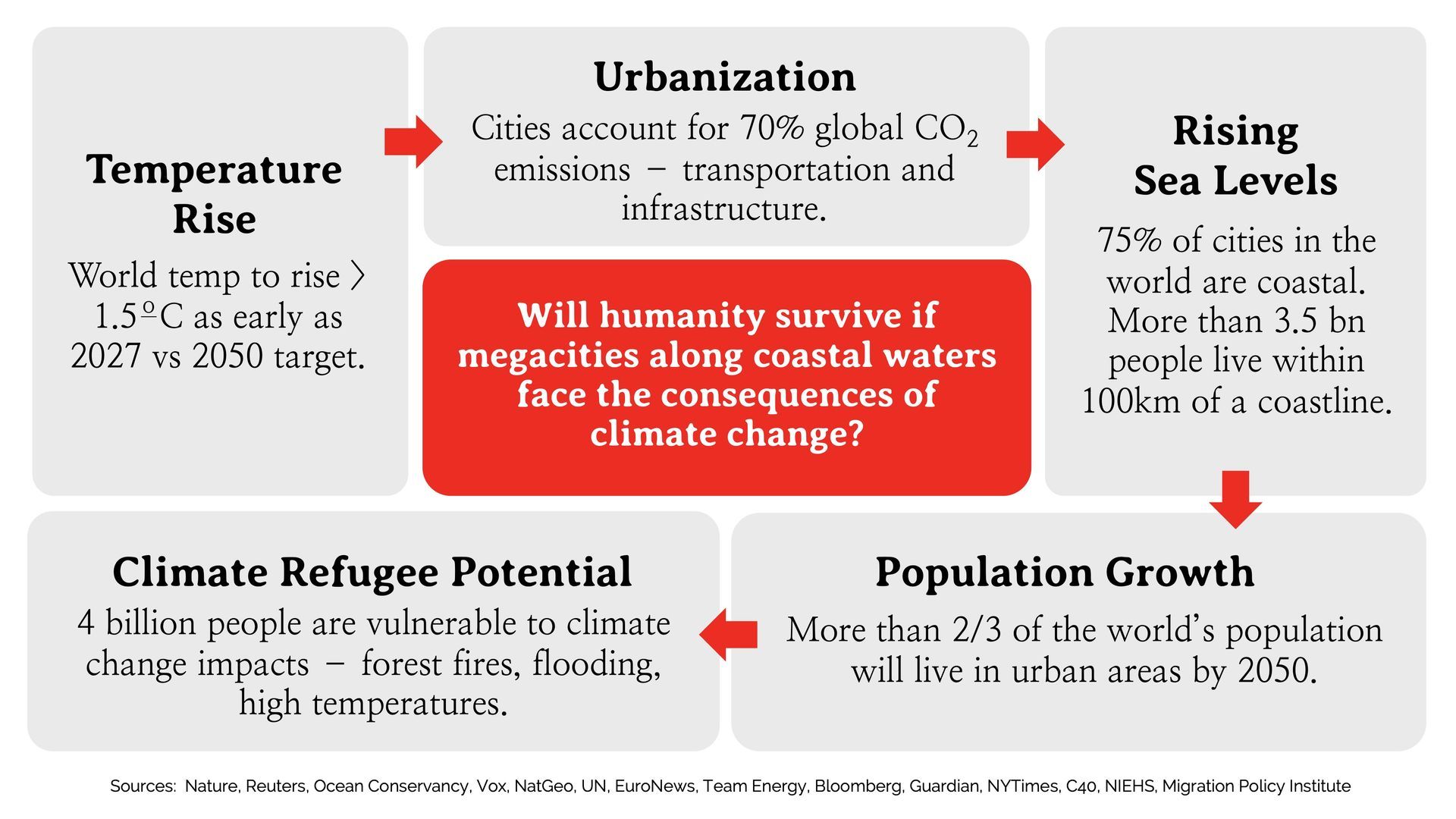
Despite global pledges, climate impacts continue to accelerate — placing
4 billion people on a path to displacement.
Our Services
Our AI models integrate vast climate databases to predict disaster risks with high accuracy, ensuring timely preparedness measures.
We help vulnerable countries build and manage their own disaster-aid capacity, reducing dependence on slow and uncertain foreign relief.
We deliver rapid-deployment solutions for medical care, clean water, sanitation, and essential supplies — when human needs are most critical.
Local Supply Chain Partnerships
We source and deploy aid through local suppliers to stabilize economies, accelerate recovery, and avoid the harm caused by free foreign aid.